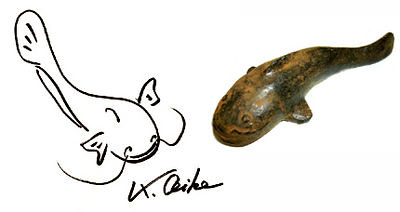
今朝は蝉なぜに啼かざる長崎忌
Why this morning
do the locusts not chirp
Nagasaki day.

こんちょう は せみ なぜに なかざる ながさきき
尾池和夫(おいけかずお)
今朝は蝉なぜに啼かざる長崎忌
Why this morning
do the locusts not chirp
Nagasaki day.

こんちょう は せみ なぜに なかざる ながさきき
尾池和夫(おいけかずお)
日陰避け歩を選び行く雪国人
ひかげ さけ ほ を えらびいく ゆきぐにびと
Avoiding shade
Picking steps
Snow country people walk
もし、ワイキキで、どちらかといえば注意深げに歩いている人を見かけたら、
「ここではブラックアイスの心配はご無用ですよ」と言ってあげてください。
日陰の水が凍ったものをブラックアイスといい、冬期の事故の悪玉です。
The first person to conceive of haiku in the modern sense was Matsuo Basho. Prior to his poetry, Japanese poets would write longer pieces utilizing the 5-7-5 pattern as an opening verse. Basho realized that this short verse by itself could be a profound and beautiful poem.
Basho’s most famous work is called 奥の細道 (oku no hosomichi / the narrow road to the interior). It is essentially a poetic travel log, wherein he recounts his experiences traveling over 1500 miles across Japan in 156 days. In it, he writes short passages followed by haiku that simultaneously conclude and embody the passages’ contents.
The combination of short story and haiku is today referred to as 俳文 (haibun). The spirit of haibun is wonderment and appreciation of the world and one’s own experiences.
一言も事実であれば話しなり
ひとこと も じじつ であれば はなし なり
A single word
that speaks of truth
can tell a story.

Frustrated by Michiko: Illustrated by Michiko
窯出しのパンの香りや今朝の秋
Freshly pulled
bread smell wafting in
a fall morning.

かまだし の パン の かおり や けさ の あき
尾池和夫(おいけかずお)
As part of the poetry appreciation project at NACOS, I devised a set of guidelines for English haiku here. However, we have since concluded that if a member is just starting out, it’s best to work from a highly abbreviated but easy to understand set of rules. Therefore, please refer to the following four steps. Once you understand them completely, you will be ready to read and comprehend the longer set of guidelines to gain an even greater understanding.
Step 1 – Image 一歩目 ~ イメージ
Begin by focusing on a concrete scene or situation. This could be anything from your present surroundings to a vivid memory to something purely imagined. Write a short description of your image to help you flesh it out.
まず、具体的な情景や場面に集中してください。これは現在のことでも、鮮明な思い出でも、単なる想像したものであってもよいのです。心に思い描いたことを小話に書いて、表現したいことを具体化してください。
Step 2 – Details 二歩目 ~ 事柄
Decide on two or three details in your image that are the most important. Your haiku poem will include only these details, and the reader will imagine the rest of the scene for him or herself.
そのイメージから二、三の最も言いたい事柄を切り取ってください。俳句には、これだけを含めます。読者は、そのほかを想像します。
Step 3 – Length and balance 三歩目 ~ 長さ、バランス
When writing an English haiku, aim for a length of around 10-14 syllables. Make the first and last lines the same length. Your purpose is to create a poem that can be spoken in one breath.
英語の俳句を書くのに、10から14の音節という長さを目指してください。最初の行と最後の行は同じ長さということを確かめてください。あなたの目標は、ひと呼吸で言える詩を詠むことです。
Step 4 – Flow 四歩目 ~ 流れ
Read the poem aloud and check the rhythm and the sound of the words. Balance stressed words with unstressed, and if a string of words is awkward to say, change it.
詩を、声を出して読んで、言葉の音とリズムをチェックしてください。アクセントのある言葉とない言葉をバランスよくさせます。もし言葉の一連が言い難ければ、別の言葉を使います。
I was very fortunate to have run the Honolulu marathon on December 9th. There were some 31,000 runners signed up to run so I knew it would be very crowded. I live about a 20 minute walk from the starting line so I walked to the start as I usually do and slowly made my way into the crowd to a point that I wanted to start from. When I got myself set to where I wanted to start at I at the runner standing next to me and couldn’t believe that he was an old friend of mine that I hadn’t seen in about two years! Once the race started I had another unlikely meeting with a friend who just happened to be running next to me! As I was heading down Kalanianole highway someone yelled my name from a group of runners going in the opposite direction and once again an old friend of mine. Finally, when I went to pick up my shirt at the pick up booth, the person standing in front of me was a friend that I hadn’t seen in about 3 years. So even though there were so many runners I ended up seeing about 5 or 6 people that I haven’t seen in a very long time.
For the last few months I’ve been in Australia, just south of a famous spot called the G0ld Coast. Lots of Japanese people are drawn to the Gold Coast as it has lovely long white sandy beaches, a great sub tropical climate, internationally acclaimed restaurants, and shopping and a nice mixed community of people from everywhere.
My partner, Michael and I have temporarily relocated here from Hawaii with Jaya and Bali, for the short term future. We are working reestablishing Massage Masters School see http://www.mmsschool.com. Australia is in the summer right now, so with Christmas approaching we will have a summer time Christmas. This will be a first for Michael, being from California, and living in Hawaii. Everyone here is busy preparing for Christmas, people are throwing parties, and beginning their holidays this week, and busily shopping for the big day.
Merry Christmas!
三陸の釣りたて鰹復活す
In Sanriku
fresh caught tuna appear
once again.

さんりく の つりたて かつお ふっかつ す
尾池和夫(おいけかずお)
突風の脅した壁にお湯の音
とっぷう の おどした かべ に おゆ の おと
A strong gust
threatens the wall behind
whistling tea.
NACOS tips for writing English haiku
Haiku are sparse, but their purpose is usually to paint a vivid image. The reader is always meant to infer most of the image for him or herself, which means that each time the poem is read, a different image will emerge. The details you choose include will determine which parts of that image must remain constant no matter how the poem is read. So, be sure to include things that resonate well with each other while also causing a scene to spring up around them due to the mind’s associations.
In the case of the above poem, I thought wind and the whistle of a tea kettle resonated well with each other because of the interplay of sounds. In addition, hot tea is associated with cold weather and the comfort of the home. Coupled with the strong wind in the first line, the scene is one of people staying at home when the weather is nasty outside. Although this was my intention, I must also welcome different interpretations. Because the details I included are interesting and evocative unto themselves, the haiku works no matter what scene the reader ends up constructing for himself.

Frustrated by Michiko: Illustrated by Michiko
One of the essential items that I had to have while living here in Chicago was an electronic keyboard. I’ve been playing the piano for about 9 years now and it’s something that I definitely wanted to keep up. For me, playing has always been a type of therapy. While I play, I can forget about all of worries and troubles in my life and just get lost in the music. Even though it may only be for 5 minutes, it is 5 minutes doing something I truly enjoy.
Currently I am learning Moonlight Sonata. To me, the song has a lot of emotion with a sort of melancholy feel. I am very excited to learn the whole song. More to come…